Kickoff meeting for a Georgia Silicosis Prevention Coalition
On November 2, Dr. Jenny Houlroyd convened OSHA, the Georgia Department of Public Health, Sur Legal Collaborative and the silicosis team to propose a Georgia Silicosis Prevention Coalition. A summary of the presentations, with the recording.
On November 2, 2026, Dr. Jenny Houlroyd convened a meeting to propose a Georgia Silicosis Prevention Coalition. Participants included OSHA's Atlanta regional office, the Georgia Department of Public Health, Sur Legal Collaborative, the National Council for Occupational Safety and Health, clinicians, community organizers, and the Chemical Equity Initiative's silicosis team, represented by Lillian Sharp. A recording of the presentations is below.
Background: Dr. Houlroyd
Dr. Houlroyd joined Georgia Tech's OSHA Consultation Program in 2005. The program, funded by OSHA since 1978, provides no-cost on-site safety and health assistance to small businesses in Georgia. At that time, countertop shops fabricated mainly granite, and exposures that exceeded the limit were generally brought under control by switching to wet cutting, confirmed by resampling.
In the mid-2010s, consultation visits began to record markedly higher exposures. Resampling ruled out a measurement problem and identified the cause as artificial stone, a product with a crystalline silica content of 90 to 99 percent. Compared with natural stone, fabrication of artificial stone produces smaller particles with different shape, surface area and electrostatic charge, and releases volatile organic compounds from the resins that bind the slab.
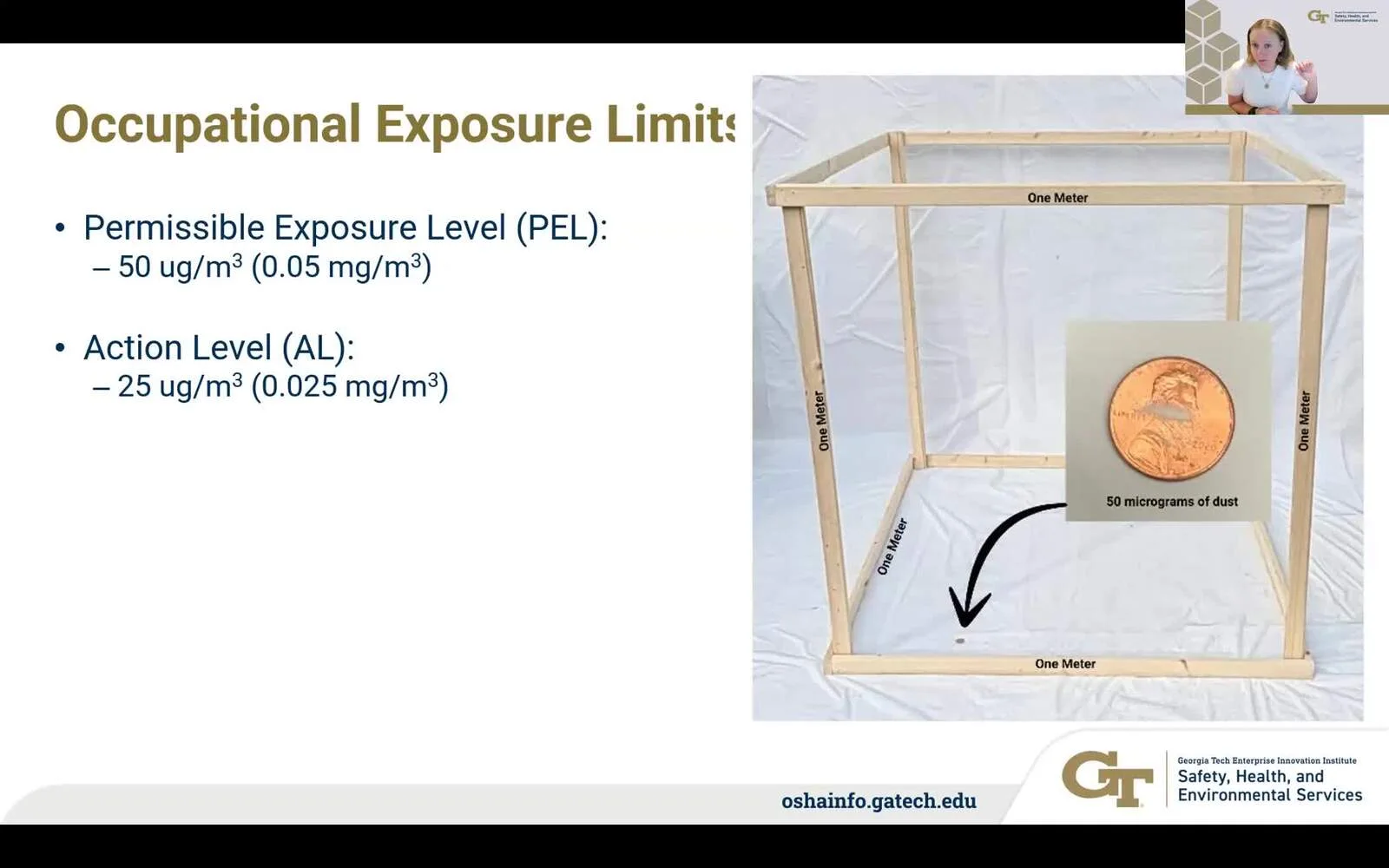
OSHA's permissible exposure limit for respirable crystalline silica is 50 micrograms per cubic meter of air, with an action level of 25. To illustrate the quantity, Dr. Houlroyd showed 50 micrograms of sweetener on a penny, photographed inside a frame one meter on each side.
Between November 2017 and July 2023, the consultation program collected full-shift air samples from 75 workers during 17 visits to 11 Georgia fabrication shops. The 95th percentile of projected exposures had a credible interval of 418 to 935 micrograms per cubic meter. Of the 63 workers who used wet methods exclusively, 51 percent had exposures above the permissible exposure limit and 70 percent above the action level. Results for shops with fewer than 25 workers and shops with 25 or more were comparable. The conclusion of the published analysis is that engineering controls do not consistently reduce exposures below the limit for slabs with this silica content, and that elimination and substitution, higher in the hierarchy of controls, should be emphasized, with respiratory protection for all workers in the interim.
No case of artificial-stone silicosis has been officially diagnosed in Georgia. California, which conducts active surveillance, has recorded 678 cases, compared with roughly 50 estimated in a 2023 publication. A review published in the American Thoracic Society's journal, to which Dr. Houlroyd contributed, identified more than 6,000 cases worldwide. On the prevalence rates reported in that literature, 20 to 30 percent of workers fabricating artificial stone could develop silicosis.
The silicosis team: Lillian Sharp
Lillian Sharp, a fourth-year biochemistry student, has been a member of the silicosis team since it was founded two and a half years ago. The team was formed to raise awareness of the disease in support of making silicosis a reportable condition in Georgia.
The initial work consisted of a literature review, including the surveillance program in California, and network building. The team produced a pamphlet to standardize the information it presents, distributed first to student organizations on campus, many of them pre-health, and subsequently to free clinics in Fulton County, where it may reach workers seeking care and the clinicians treating them.
In an earlier semester the team surveyed stone shop foremen on what their shops know about silicosis and the personal protective equipment workers use and have access to. The sample was drawn from industry classification codes for stone shops in Georgia, narrowed to those fabricating engineered stone countertops. The survey drew some engagement but no complete responses; the work contributed to the team's network.
This semester the team is the largest it has been and is working on three fronts. Lillian and one other student are developing the pamphlet into one-page documents for employers, workers and health care professionals, in collaboration with Dr. Houlroyd and the Georgia Department of Public Health. A second group is extending the team's network of clinicians and patients with Dr. Lucy Shi of Emory. A third is studying Emory's lung transplant program, how patients obtain transplants, and the economic costs associated with them.
Presentations from the partners
Marcelina Santiago, senior industrial hygienist in OSHA's Atlanta regional office, presented enforcement data. A national emphasis program for the engineered stone industry, launched in September 2023, resulted in 204 targeted inspections, 42 complaint inspections, 68 overexposures and more than 1,000 citations in its first ten months, and prompted a hazard alert. Over the past three years OSHA conducted 521 silica inspections nationwide, 63 of them in the Atlanta region, which covers Georgia and Florida, the third-highest count after New York and Chicago. Of the 63, 36 were programmed inspections, 13 followed complaints and 7 were follow-ups. The standards most often cited were respiratory protection, the silica standard and hazard communication.
Antoinette Lavender, occupational health epidemiologist at the Georgia Department of Public Health, presented the state's surveillance data. Georgia is one of 22 states funded by NIOSH to conduct occupational health surveillance, which includes hospitalizations and deaths with pneumoconiosis. From 2015 to 2024, Georgia recorded 127 hospitalizations and 10 deaths with silicosis; from 2020 to 2024, 20 emergency department visits. Twenty-eight of the hospitalized patients and nine of the emergency department patients were 54 or younger, the age range characteristic of accelerated silicosis. Most hospitalized patients were Black, non-Hispanic men. Because silicosis is not a reportable condition in Georgia, the department relies on lagged hospital, emergency department and death certificate data and cannot obtain medical records, work histories or follow-up with patients. She also cited a 2023 California study in which 58 percent of patients experienced a delayed diagnosis, most often after an initial diagnosis of another pulmonary condition; of eight patients initially diagnosed with tuberculosis, one was confirmed. Her recommendations were earlier case detection, active case surveillance, and education of health care providers on occupational history.
Aimee Pacheco, staff attorney at Sur Legal Collaborative, and Lucia, its worker organizer, described plans for worker outreach: educational materials in English, Spanish and Portuguese; the National COSH worker alert flyer, adapted with regional contact information; surveys in the three languages; pocket cards that workers can bring to medical appointments listing job type, exposure history and recommended tests; and short videos edited from worker testimony footage that Georgia Tech has agreed to share. They asked partner organizations for help with digital outreach, policy work and distribution.
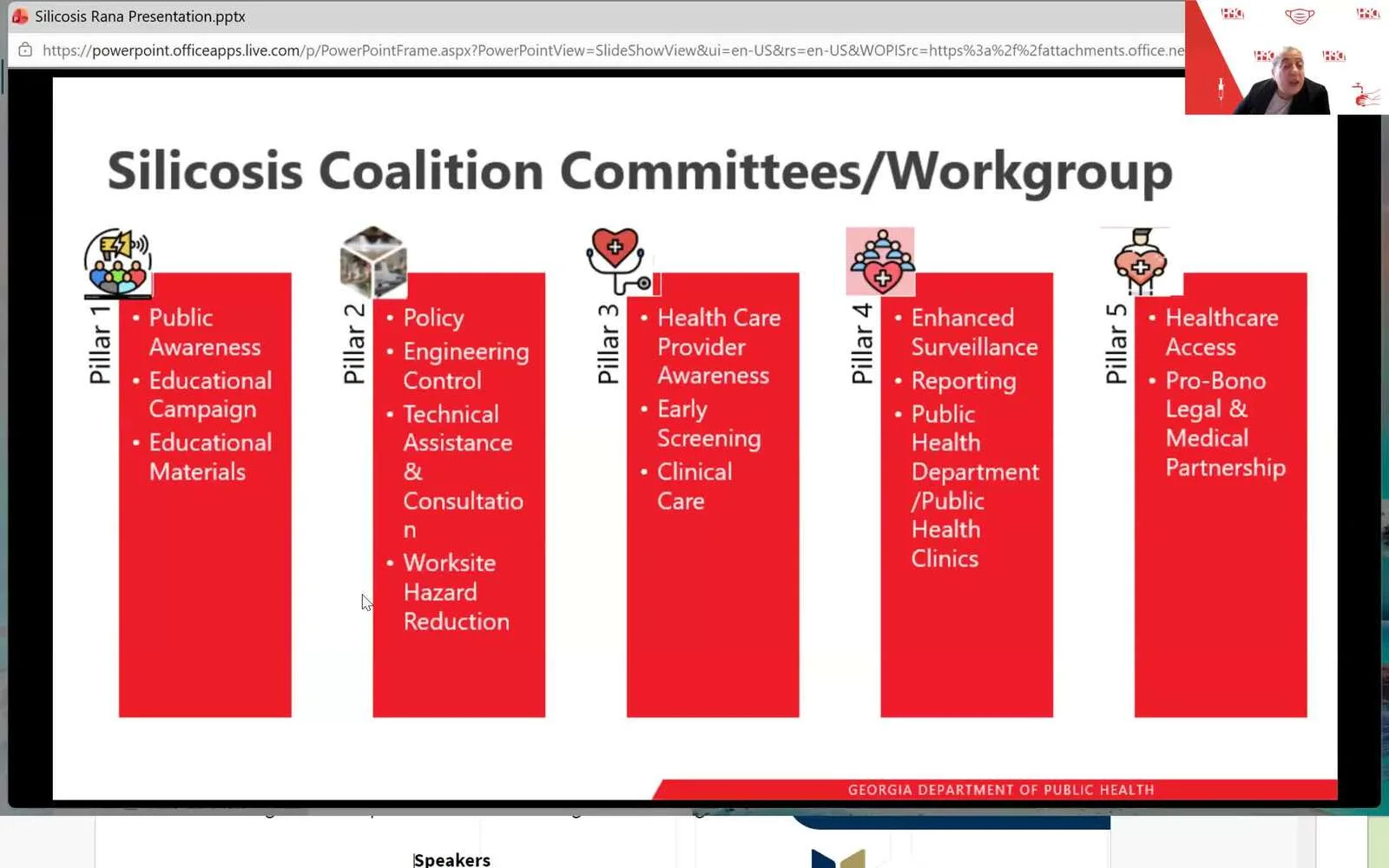
Rana Bayakly, chief epidemiologist for chronic disease, health behavior and injury epidemiology at the Georgia Department of Public Health, presented the proposal. The coalition would have five working groups: public awareness and education; policy, engineering controls, technical assistance and worksite hazard reduction; health care provider awareness, early screening and clinical care; enhanced surveillance and reporting; and health care access with pro bono legal and medical partners.
Next steps
A steering committee will draft the coalition agreement by mid-December 2026. The working groups will then prepare a plan of goals and activities for presentation to the state epidemiologist and department leadership by July 2027. The minimum objective is to make silicosis a reportable condition in Georgia.
Participants identified groups not yet represented: legislators, employers, insurers, the State Board of Workers' Compensation and the American Lung Association. Dr. Lucy Shi, who was scheduled to present, was unable to attend.