Modeling Time-Dependent Chemical Concentrations in Confined Spaces for General Safety Applications
The Modeling Team's open-source model predicts how fast a chemical vapor builds up in an enclosed space, published in ACS Chemical Health & Safety.
Godavarti, D.; Simbafo, W.; Pederson, J.; Houlroyd, J.; Pollet, P., ACS Chemical Health & Safety, 2026
Enclosed spaces with little or no ventilation are a major source of chemical exposure risk in many jobs. The Modeling Team built and verified an open-source computational fluid dynamics (CFD) diffusion model that predicts how the concentration of a chemical vapor changes over time in a space of a specific shape. The aim is to make foundational, diffusion-based exposure models accurate, reliable, and usable by people who are not modeling specialists.
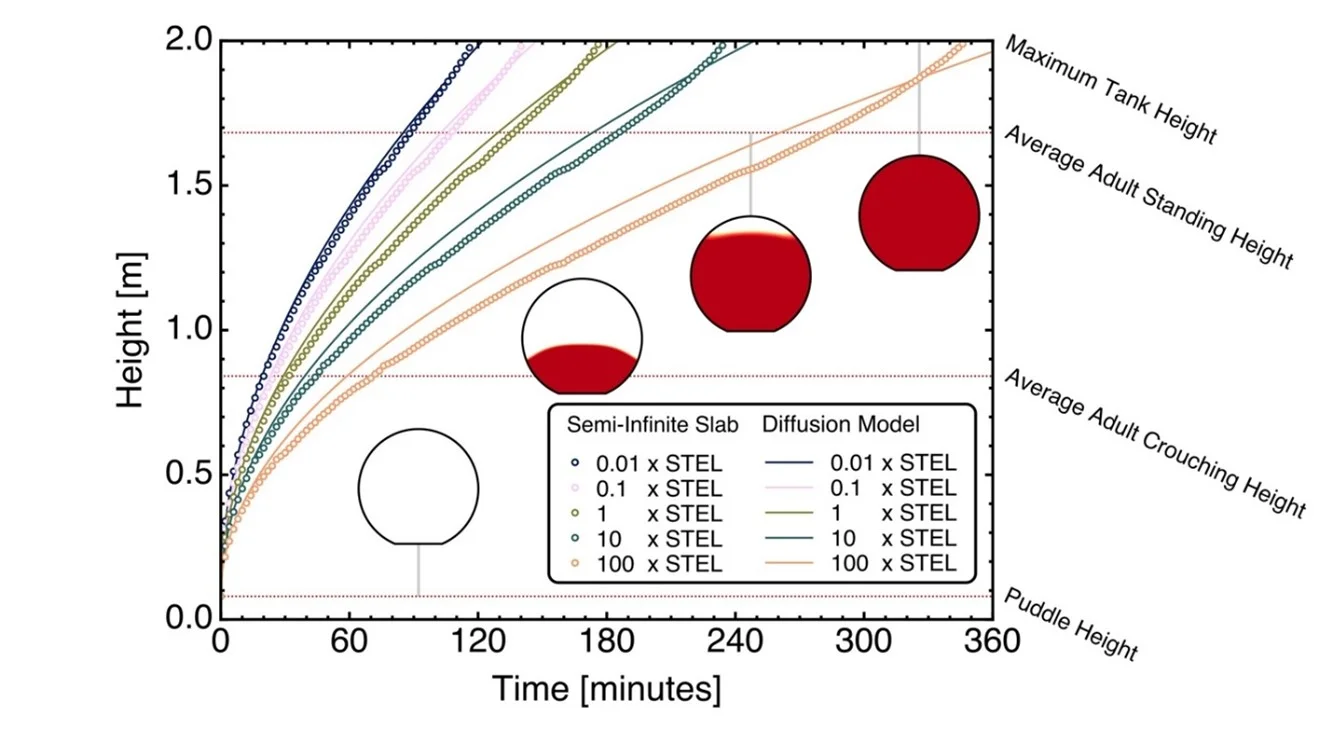
To check that the model converges, the team ran a refinement study on its mesh and time step. They then used it to track the vapor front of benzene, a carcinogen chosen as the model compound, through the headspace of a truck tank, measured against benzene's OSHA short-term exposure limit of 5 ppm.
At early times the model matched the analytical semi-infinite medium solution. Later the two diverged, because of transverse diffusion set by the tank's geometry. The paper quantifies those deviations, reports exposure timelines that depend on a worker's posture, and includes sensitivity analyses for temperature and for the height of the liquid pool.
The authors conclude that transient, geometry-aware modeling matters for risk assessment, and that it complements physical sampling and ventilation planning. Because the model is built on OpenFOAM and its code is shared openly, the approach is not limited to commercial CFD tools.
Godavarti, D.; Simbafo, W.; Pederson, J.; Houlroyd, J.; Pollet, P. ACS Chemical Health & Safety 2026, 33 (3), 516–527. Published April 15, 2026, open access. The authors are at Georgia Tech: Godavarti and Simbafo in the School of Chemical and Biomolecular Engineering, Pederson and Pollet in the School of Chemistry and Biochemistry, and Houlroyd in Safety, Health and Environmental Services.